

Introduction to Membrane Bioreactor Technology
Membrane Bioreactor (MBR) technology revolutionizes wastewater treatment by merging biological processes with advanced membrane filtration. Unlike traditional methods, Membrane Bioreactors (MBR) for Wastewater Treatment produce high-quality effluent suitable for reuse, making them ideal for water-scarce regions.
This guide explores how MBR works, its benefits, challenges, and real-world applications. Whether you’re a municipal planner or an industrial operator, understanding MBR could transform your approach to wastewater management.
What is Membrane Bioreactor (MBR) Technology?
Membrane Bioreactor technology is a hybrid wastewater treatment process that combines biological degradation (using activated sludge) with membrane filtration. Unlike conventional systems that rely on sedimentation, MBR uses membranes to physically separate solids from treated water. The result? Crystal-clear effluent that meets even the most stringent discharge standards.
It offers a compact, efficient, and eco-friendly alternative to conventional activated sludge processes. This makes MBR ideal for tertiary wastewater treatment, water reuse, and decentralized systems.
Key Components of MBR Systems
An MBR system typically consists of the following:
- Aeration Tank – where microorganisms break down organic pollutants
- Membrane Unit – microfiltration or ultrafiltration membranes that retain solids and bacteria
- Recirculation Pump – maintains optimal biological activity
- Control Systems – for automation and process monitoring
Together, these components ensure that organic removal, nutrient reduction, and solid-liquid separation are all handled in a single, compact system.
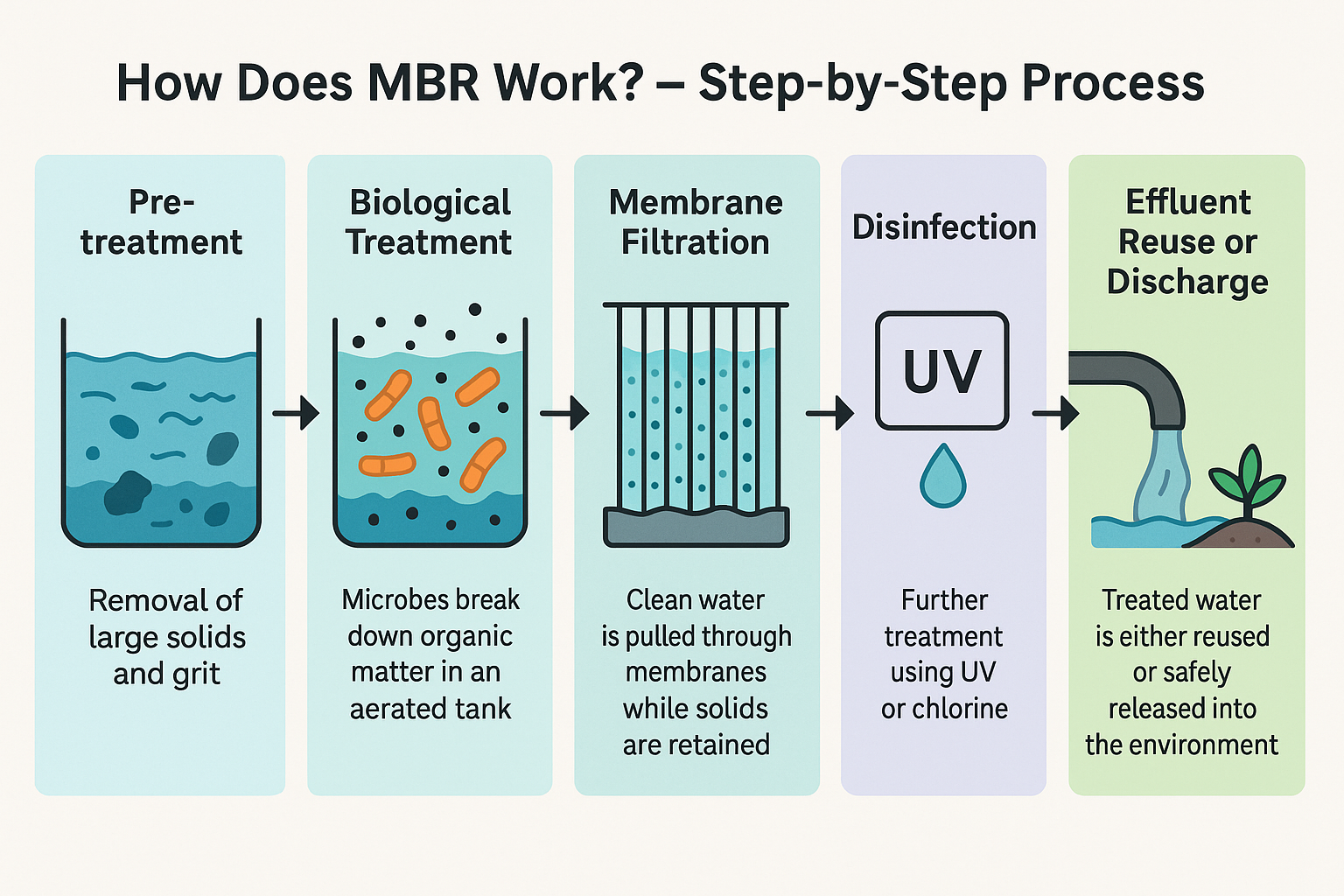
How Does MBR Work? – Step-by-Step Process
The membrane bioreactor process is an innovative way to treat wastewater, combining biological treatment with advanced filtration to produce high-quality water. Let’s break it down step by step:
- Pre-treatment – Removal of large solids and grit
- Biological Treatment – Microbes break down organic matter in an aerated tank
- Membrane Filtration – Clean water is pulled through membranes while solids are retained
- Disinfection (Optional) – Further treatment using UV or chlorine
- Effluent Reuse or Discharge – Treated water is either reused or safely released into the environment
Types of MBR Configurations
- Submerged MBR (SMBR)
- Membranes are placed directly in the aeration tank
- Lower energy use, compact design
- Side-Stream MBR
- Membranes are placed outside the aeration tank
- Suitable for industrial wastewater treatment due to higher membrane flux
Each configuration has its operational benefits and is selected based on project-specific needs.
Advantages of MBR Technology
- High effluent quality – Removes even tiny bacteria and viruses
- Compact footprint – Ideal for space-constrained locations
- Reduced sludge production – Less biomass waste to handle
- Efficient nutrient removal – Meets nitrogen and phosphorus limits
- Water reuse – Recycles treated water for flushing, landscaping, or industrial processes
These benefits make MBR one of the most sustainable wastewater treatment technologies available today.
Challenges and Limitations
Despite its advantages, MBR does have a few challenges:
- Membrane fouling – Requires periodic cleaning
- Higher capital and operational costs
- Energy-intensive – Especially in side-stream systems
- Specialized maintenance – Requires trained operators
Still, ongoing innovation in membrane materials and automated control systems is helping to address these issues effectively.
Applications of MBR in Wastewater Treatment
MBR technology is used in various sectors:
- Municipal Wastewater Plants
- Industrial Effluent Treatment Units (ETPs)
- Commercial Complexes & Malls
- Hospitals & Hotels
- Residential Townships
- Decentralized and Remote Areas
It is consistently delivering high-quality treated water, making it an ideal choice for water recycling and zero-liquid discharge (ZLD) systems. Discover our comprehensive Wastewater Treatment Solutions tailored for diverse applications.
MBR vs Other Advanced Treatment Technologies
| Feature | MBR | SBR | MBBR |
|---|---|---|---|
| Effluent Quality | Very High | Moderate | High |
| Footprint | Small | Large | Moderate |
| Sludge Production | Low | High | Moderate |
| Automation Potential | High | Medium | Medium |
Compared to SBR or MBBR, MBR offers superior results in pathogen removal and effluent reuse, making it ideal for modern treatment needs. Explore our range of Advanced Wastewater Treatment Technologies to find the best solution for your requirements.
Future Trends in MBR Technology
- Smart Sensors & AI-based Monitoring
- Next-Gen Membranes with anti-fouling properties
- Integration with solar or wind energy systems
- Growth in modular MBR systems for plug-and-play applications
The future of MBR lies in scalable, decentralized treatment and energy-efficient designs.
Benefits of Choosing SCT Water MBR Solutions
At SCT Water, we specialize in delivering customized MBR wastewater treatment systems designed to meet your specific water quality goals.
Why choose SCT Water?
- Proven expertise in industrial and municipal wastewater treatment
- Advanced membrane technology with anti-fouling features
- Energy-efficient designs that lower operational costs
- Remote monitoring and automation capabilities
- Comprehensive support and maintenance services
Whether you’re looking to upgrade your existing STP or build a new plant, SCT Water ensures cleaner, smarter, and more sustainable solutions.
The Membrane Bioreactor has revolutionized wastewater treatment by offering unmatched efficiency, reliability, and sustainability. From municipal bodies to industrial plants, the adoption of MBR systems is a testament to their long-term value. With growing environmental regulations and the pressing need for water conservation, embracing MBR technology isn’t just a choice—it’s a necessity.
Ready to make the switch to high-efficiency wastewater treatment? Contact SCT Water today and explore how MBR can benefit your facility.
Conclusion
Membrane Bioreactor (MBR) systems are revolutionizing the way we treat and reuse water. They offer unmatched effluent quality, space efficiency, and long-term sustainability. If you’re looking for the future of water treatment, MBR is it—and SCT Water is your trusted partner in making it a reality. Contact Us to learn more.
FAQs:
1 What is Membrane Bioreactor (MBR) technology?
MBR is a wastewater treatment process that combines membrane filtration with biological treatment to produce high-quality effluent suitable for reuse.
2 What are the main advantages of MBR systems?
MBR systems offer better effluent quality, a smaller footprint, and higher sludge retention compared to conventional systems.
3 Where is MBR technology commonly used?
It is widely used in sewage treatment plants (STPs), effluent treatment plants (ETPs), and industrial wastewater applications.
4 How does MBR improve wastewater treatment efficiency?
MBR eliminates the need for secondary clarifiers and filters, resulting in compact plant design and improved pathogen removal.
5 Is MBR suitable for residential or small-scale treatment?
Yes, modern MBR systems are modular and scalable, making them suitable for residential buildings, hotels, and small industries.

